
Quick answer: Most Michigan homes with a one-story roof edge are well served by a telescoping rake with a plastic (poly) blade, like the Snow Joe RJ204M, which reaches 21 feet [6]. If you have overhead service lines near the eaves, take OSHA’s advice and keep any pole at least 10 feet from them; aluminum handles conduct electricity [5]. For long, low-slope runs of roof, the Avalanche slide system moves snow without scraping [9].
At a glance
- Marquette, 2025-26 season
- 276.6 inches of snow through May 31, against a normal of 196.8 [1]
- Gaylord, winter 2024-25
- 149.5 inches from December to February, the snowiest on record at the NWS office [2]
- Grand Rapids normal
- 77.6 inches a year; 2024 came in at 75.3 [3]
- Why ice dams form
- Attic heat melts roof snow, which refreezes at the edge [4]
- Power lines
- OSHA: stay at least 10 feet away; use nonconductive poles near them [5]
Why Michigan roofs need one
Snow piles up fast here because of the Great Lakes. The National Weather Service office in Gaylord measured 149.5 inches between December 2024 and February 2025, 53.7 inches above normal and the most on record there. Sault Ste. Marie had 138.9 inches, its second snowiest winter [2]. In the Upper Peninsula, Marquette recorded 276.6 inches in the season that ended May 31, 2026, about 80 inches more than its normal of 196.8 [1]. Even Grand Rapids, farther from the snow belts, averages 77.6 inches a year [3].
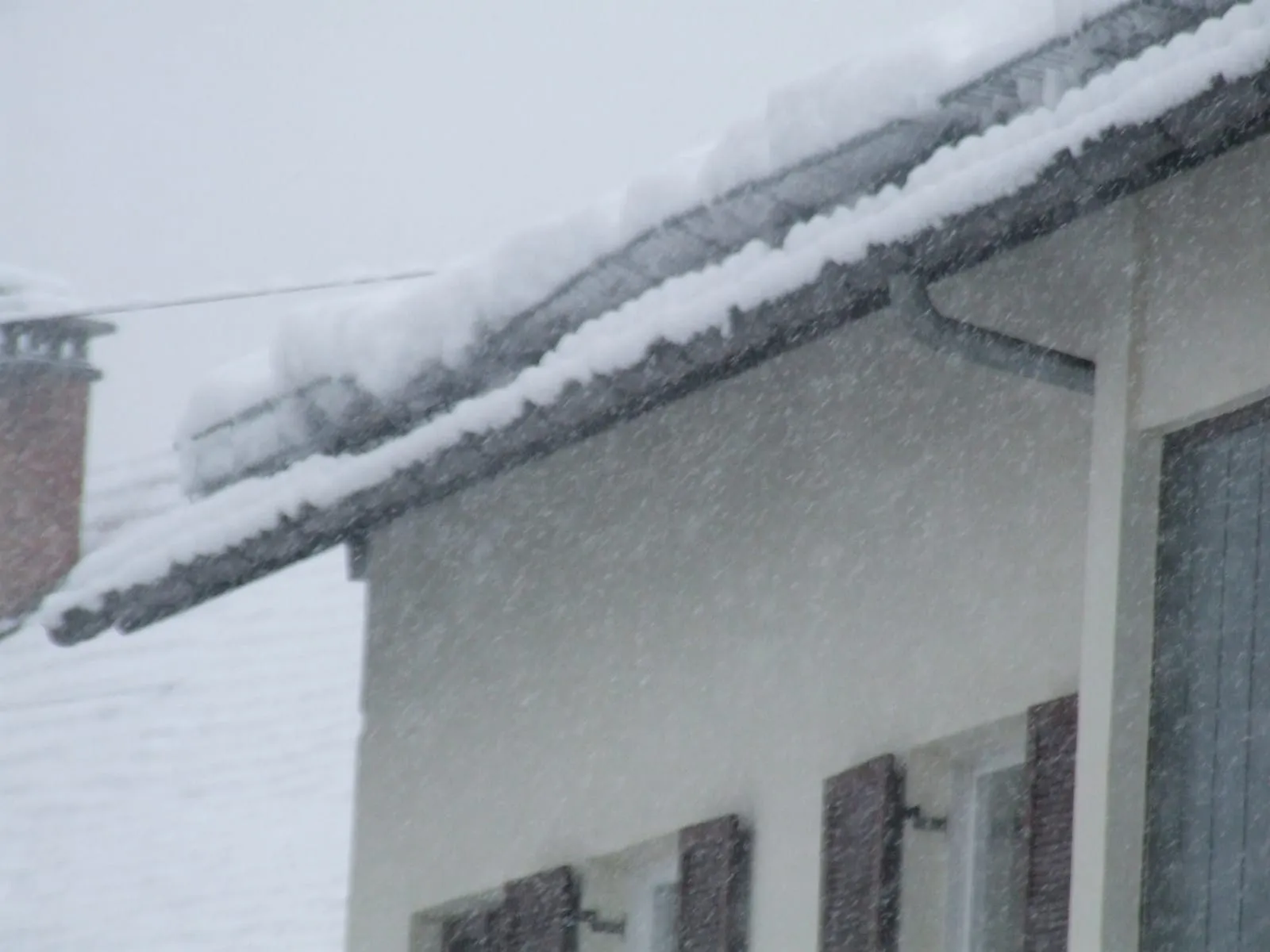
Deep snow on a roof sets up ice dams. FEMA explains that when too much heat escapes into the attic, it warms the snow on the roof; the meltwater refreezes at the colder edge and builds an ice dam, which can push water inside or even lead to a roof collapse [4]. A roof rake lets you pull the snow off the lower few feet of roof from the ground, before it has a chance to melt and refreeze.
How we chose
- Used from the ground. OSHA’s guidance for roof snow removal is to avoid going on the roof and to use snow rakes from the ground, removing small amounts at a time [5]. Every pick here works that way.
- Reach and blade material from the maker. We list the pole length and blade the maker publishes, and include both plastic and metal blades.
- Power-line safety. OSHA calls for extendable, nonconductive poles near overhead lines and a 10-foot clearance [5]. We flag every pick with a metal pole.
- Recall check. We searched the CPSC recall database for each brand and model on November 2, 2026. None of these rakes has been recalled.
Our picks
Best for: Two-story eaves and most shingle roofs
Snow Joe Roofer Joe 21 ft. Telescoping Roof Rake, Poly Blade (RJ204M)
The longest reach here from a single twist-lock pole, with a wide plastic blade that is light enough to handle at full extension.
- Pole extends from about 6.2 to 21 ft; Snow Joe says up to 27 ft of overhead reach [6]
- Poly rake head, about 25 in. wide and 6 in. tall [6]
- 4.8 lb; 2-year warranty [6]
Safety check: No safety certification applies to a hand rake. No CPSC recall found for the RJ204M (checked 2026-11-02).
Watch out: The pole is aluminum, which conducts electricity. Keep it at least 10 feet from overhead lines, as OSHA advises [5]. A 21 ft pole also gets heavy and flexes at full length.
See it on Amazon → We chose it from specs and safety records; we haven't tested it ourselves.
Best for: Heavy, wet late-season snow
Snow Joe Roofer Joe 21 ft. Telescoping Roof Rake, Aluminum Blade (RJ205M)
The same 21 ft pole as the RJ204M, but with an aluminum blade, which is stiffer when the snow is dense or has a crust on it.
- Pole extends from 6.2 to 21 ft [7]
- Aluminum blade, 25 in. long and 6 in. wide [7]
- 5.7 lb; 2-year warranty [7]
Safety check: No safety certification applies to a hand rake. No CPSC recall found for the RJ205M (checked 2026-11-02).
Watch out: A metal blade can scrape shingles if you drag it hard, so pull gently and leave a thin layer. Both the blade and pole are aluminum, so the power-line warning applies here too [5].
See it on Amazon → We chose it from specs and safety records; we haven't tested it ourselves.
Best for: Ranch homes, garages and sheds
Garant 24 in. Telescopic Roof Rake, Poly Blade (GPRR24T)
A shorter pole is easier to control on a single-story roof, and the 24 in. blade still clears a wide strip in each pass. Garant also lists it for awnings and tarps.
- Telescopic aluminum handle extends to 16.5 ft [8]
- 24 in. wide poly blade [8]
- Oval, textured handle for grip [8]
Safety check: No safety certification applies to a hand rake. No CPSC recall found for Garant roof rakes (checked 2026-11-02).
Watch out: 16.5 ft won't reach the eaves of most two-story homes. The handle is aluminum, so keep clear of overhead lines [5].
See it on Amazon → We chose it from specs and safety records; we haven't tested it ourselves.
Best for: Long, low-slope roofs with deep snow
Avalanche! Original 500 Roof Snow Removal System (AVA500)
Instead of pulling snow down, you push a cutter frame up the roof and the snow slides down a plastic sheet. It works well on big snowfalls where a blade would mean dozens of pulls.
- Four 4 ft fiberglass poles joined with couplers [9]
- Cutter frame with a slide kit and wheels [9]
- 6-month limited warranty; the plastic slide is a replaceable wear part with no warranty [9]
Safety check: No safety certification applies to a hand rake. The manual warns to keep away from electrical wires. No CPSC recall found for the AVA500 (checked 2026-11-02).
Watch out: The manual says plainly that it does not remove ice dams [9]. Snow comes down the slide toward you, so stand to the side. Its couplers are aluminum even though the poles are fiberglass.
See it on Amazon → We chose it from specs and safety records; we haven't tested it ourselves.
Buying guide
- Measure first. Stand where you’ll rake and estimate the distance to the roof edge plus a few feet up the slope. A 16 ft pole is enough for most single-story homes; a two-story roof needs about 21 ft.
- Clear the edge, not the whole roof. The point is to keep snow off the lower part of the roof so meltwater has nothing to refreeze against. Avalanche suggests keeping about 5 feet of the roof edge clear [9].
- Pull small amounts. OSHA tells workers to remove small amounts of snow at a time with a snow rake [5]. Large slabs can slide off all at once.
- Fix the attic too. A rake treats the symptom. FEMA notes that a properly insulated attic helps guard against ice dams [4].
Sources
- National Weather Service Marquette: Climatological Report (Monthly), May 2026, Marquette, MI
- National Weather Service Gaylord: Winter 2024-25 Climate Summary
- National Weather Service Grand Rapids: Climatological Report (Annual), 2024
- FEMA: How Can Winterizing Your Home Help You Prepare?
- OSHA: Falls and Other Hazards to Workers Removing Snow from Rooftops and Other Elevated Surfaces (OSHA 3513)
- Snow Joe: Roofer Joe 21 ft Twist-N-Lock Telescoping Roof Rake (RJ204M)
- Snow Joe: Roofer Joe 21 ft Twist-N-Lock Telescoping Aluminum Roof Rake (RJ205M)
- Garant: Roof Rake, Telescopic Handle, 24 in. Poly Blade (GPRR24T)
- Marshalltown: Avalanche! Original 500 and 750 Product Manual
Common questions
Does a roof rake stop ice dams?
It helps, but it isn't a cure. FEMA says ice dams form when heat escaping into the attic melts roof snow that then refreezes. Pulling snow off the lower edge of the roof removes some of the snow that feeds the dam, but attic insulation and air sealing deal with the cause. Avalanche's own manual says its rake does not remove ice dams.
Can I use a roof rake from a ladder?
OSHA tells workers not to use a snow rake or shovel while on a ladder, because it greatly increases the risk of losing balance and falling. Roof rakes are made to be used from the ground.
Are aluminum roof rakes dangerous near power lines?
Yes. OSHA lists electrocution from contact with power lines among the hazards of roof snow removal. It calls for nonconductive poles near overhead lines and staying at least 10 feet away from them. Look up before you extend any pole.